
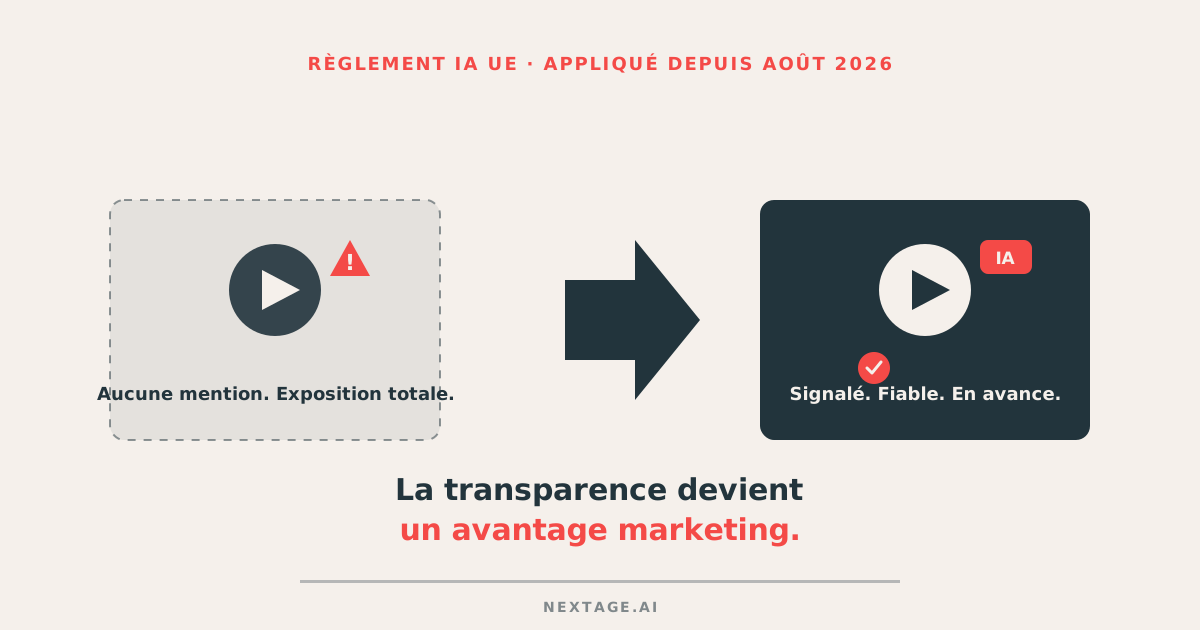
Article 50 enforcement went live August 2nd — brands, not just AI tool providers, carry the disclosure obligation, with fines up to €15M. Most brands still aren't labelling AI content, which makes early, visible compliance a trust advantage rather than just a legal box to tick. Nextage's own co-founder was quoted on this shift in Belgian business press. The piece closes with three practical checks readers can run before their next AI campaign ships, and points to the full compliance guide for the step-by-step version.

Three weeks after the EU AI Act's transparency rules took effect, most brands running AI-generated ads into Europe still have no label on them — and no plan to add one. That gap is no longer a compliance footnote. It's the difference between the brands enforcement catches first and the brands that get to point at their process and move on.
If you're producing AI content for European audiences, this is the moment the conversation changed. Not "should we think about AI regulation eventually." Enforcement is live, national authorities are watching, and the brands treating disclosure as a differentiator — not a scramble — are the ones about to look serious in front of clients, procurement teams, and platforms alike. Nextage co-founder Jean-Marc Segati was among the industry voices Belgian business daily L'Echo turned to when covering the rollout — more on what he told them below.
Get the free AI Content Compliance guide →
What actually changed on August 2nd
Article 50 of the EU AI Act stopped being a future date on a compliance calendar and became current operating reality. Three things became enforceable at once: AI chatbots have to identify themselves, AI-generated or manipulated content that could pass for real has to carry a machine-readable mark, and content depicting a real-looking person needs a visible disclosure the audience can actually see. Fines for getting it wrong run up to €15 million or 3% of global annual turnover — whichever is higher — enforced jointly by national market surveillance authorities, the EU's AI Office, and the European Data Protection Supervisor.
The rule doesn't care where your company is headquartered. It follows where the content lands. A brand in Antwerp or Austin running an AI-generated video ad into France or Germany is inside scope either way.
Here's the part most marketing teams miss: the tool you used to make the content isn't the one carrying the obligation for how it's shown to your audience. Your AI vendor has to tag its outputs so they're machine-detectable — that's their job. Whether your audience can actually see that a realistic-looking spokesperson, testimonial, or scene was AI-made is yours. You can license the most compliant tool on the market and still be the one holding the fine if nobody labelled the finished ad.
Belgian business daily L'Echo covered this exact rollout as it took effect (journalist Pauline Denys, published 1 August 2026)speaking to agencies working in AI content production about what it changes for them. Nextage co-founder Jean-Marc Segati put it plainly: agencies like his are up against plenty of "freelance cowboys" — his words for operators who, as he told the paper, do "a bit of everything, any old way," putting the advertisers who hire them at risk. The article reports Nextage plans to launch its own compliance label this month, covering full AI Act alignment, GDPR, data handling, and image-rights clearance. The read from inside the industry lines up with the point this piece is making: the new rules are a way to separate serious production partners from the rest of the market, not just a box to tick before a deadline.

The same rule, two very different responses
Watching how AI providers themselves are handling this tells you something useful about where the industry is heading. Anthropic began watermarking Claude's text output globally in mid-August — not because every user is in the EU, but because it doesn't yet have a reliable way to apply the rule by region. Google took the opposite path with Gemini and its Flow video tool: users can now switch the visible watermark off entirely, while the invisible SynthID marking and C2PA metadata stay on underneath, unaffected by the toggle.
Same regulation, same August deadline, two different bets on what "compliant" should look like to the person actually seeing the content. One version treats disclosure as something the audience should be able to notice. The other treats it as something that should be technically present but invisible unless someone goes looking.
That's not a footnote for AI labs — it's a decision every brand producing AI content is now making too, whether deliberately or by default. Do you disclose in a way your audience actually registers, or the minimum your tools happen to embed automatically? Early data suggests most consumers want the first option: they say they want AI content labelled, even as most brands still aren't doing it consistently. That gap between what audiences expect and what brands are shipping is exactly where trust gets won or lost over the next two quarters.
Where the real exposure sits — and it isn't the fine
The headline number is the fine. The more common failure mode is smaller and far more disruptive: a campaign gets pulled mid-flight because legal flags a gap after launch, or a client's procurement team asks which AI tools were used and how outputs are rights-cleared — and nobody on the account can answer.
A pattern that keeps showing up across the industry: a mid-sized brand launches a video campaign with AI-generated presenters. It performs well, right up until a retail partner's legal team requests documentation on tool usage and rights clearance. Nobody has it. The agency that produced the work never kept records either. The campaign pauses three weeks before a major retail moment while the team scrambles to reconstruct what was actually used.
The fix, once it's in place, is almost unremarkable: a one-line log per deliverable — which tool made it, what rights apply, how it's disclosed. It takes an afternoon to set up. The next audit, months later, takes fifteen minutes instead of three weeks, because the answers are already written down. That's not a legal department's job to build. It's a production discipline, and it belongs in your creative brief from day one — not bolted on after a partner asks the question twice.
Reliability is the quieter problem sitting underneath compliance
A second story running in parallel this month doesn't get filed under "regulation" but points at the same gap. New agentic AI benchmarks test whether AI systems can finish a full task end-to-end, not just answer a prompt well — and the results are humbling. One commerce benchmark found the best-performing agent setup completed just 66 of 107 real tasks. A separate long-workflow benchmark averaged 6.4% across 17 frontier models, with most failures simply timing out before completion.
Put the two stories side by side and the throughline is obvious: AI that looks fluent in a single response and AI that reliably finishes a whole production run are two different things. That's why "AI-generated" and "AI-directed" aren't the same claim. Content that's fast to produce but has no traceable process behind it is exposed on both fronts: harder to defend if a regulator or client asks a question, and with no human checkpoint confirming the output did what the brief asked. Traceability and human review aren't just what Article 50 wants to see — they're the same discipline that keeps AI production dependable in the first place.
What to check before your next AI campaign ships
You don't need a legal team on standby to close most of this gap. Three questions are worth running through before your next brief goes out:
- Can you name every AI tool touching this deliverable, and do you know its commercial output rights? If the terms are silent on commercial use or ownership, that's a flag, not a footnote.
- Does anything in this campaign show a realistic-looking person, voice, or scene that could be mistaken for real? If yes, the disclosure needs to be visible to the person watching — not just embedded in metadata nobody sees.
- If someone asked next month which tool made this and how it's rights-cleared, could you answer in five minutes? If the honest answer is "no," that's the gap to close first — before it becomes an audit, a paused campaign, or a stalled contract.
None of this requires slowing production down. It requires building the paper trail at the same pace you're already building the campaign.
The brands treating this as an advantage, not a chore
The teams getting ahead of this aren't the ones panicking about fines. They're the ones treating "documentable and defensible" as part of what good creative production means now — and saying so, out loud, to clients asking the same questions internally. Traceable production, rights-clean tools, and disclosure built in from the brief aren't just how you avoid a penalty. They're how you answer a procurement question in one meeting instead of three weeks.
If you want the fuller operational picture — the four questions your legal team will ask, a framework for evaluating any AI tool in your stack, and a step-by-step readiness plan you can start this week — the AI Content & Compliance Guide walks through all of it, free. the AI Content & Compliance Guide walks through all of it, free.
And if you're weighing what AI-directed production actually looks like when traceability and creative quality aren't a trade-off, our commitment to creating responsibly with AI and our recent productions are worth a look before your next brief goes out. If you're comparing what a compliant, AI-accelerated production setup costs against what you're paying now, our services page breaks down the formats and timelines directly.
We covered a related angle — what actually separates AI video campaigns that stand out from ones that blend into the feed — in last month's newsletter recap, if you want the creative-differentiation side of this conversation next. last month's newsletter recap,, if you want the creative-differentiation side of this conversation next.
We covered a related angle — what actually separates AI video campaigns that stand out from ones that blend into the feed — in
A Project in Mind?
Whether you have a clear brief or a half-formed idea, we can help you shape it into something worth making.


 French
  English